Custom Software vs Ready-Made Software: Which Is Better for Your Business?
Your business is unique. Your software should be too.
Every business has its own processes, customers, employees, workflows, challenges, and growth plans. Yet many companies rely on ready-made software that forces them to adjust their business processes around the limitations of the software.
This is where custom software development can make a significant difference.
Custom software is designed specifically around your business requirements, allowing you to automate processes, integrate systems, improve productivity, strengthen security, and scale as your business grows.
But is custom software always better than ready-made software?
Let's compare both approaches and understand which solution makes sense for your business.
What Is Custom Software?
Custom software is an application developed specifically for a particular business or organization.
Instead of purchasing a standard product and adapting your business to it, custom software is designed around the way your business actually operates.
A custom software solution can include exactly the modules your organization needs, such as:
- CRM and lead management
- Sales and quotation management
- Inventory management
- Billing and invoicing
- Employee management
- Customer portals
- Vendor management
- Business dashboards
- Reports and analytics
- WhatsApp integration
- Payment gateway integration
- Email and SMS automation
- AI-powered features
- API integrations
The objective isn't to create software with hundreds of unnecessary features.
The objective is to create software that solves your specific business problems.
What Is Ready-Made Software?
Ready-made software is developed for a large number of businesses and customers.
Examples include general-purpose CRM systems, accounting applications, project management tools, inventory applications, HR software, and other SaaS platforms.
The major advantage is speed.
You can generally:
Purchase → Configure → Install/Subscribe → Start Using
This makes ready-made software attractive for businesses that need standard functionality quickly.
However, because the same software is designed for many different organizations, its workflow may not perfectly match your business.
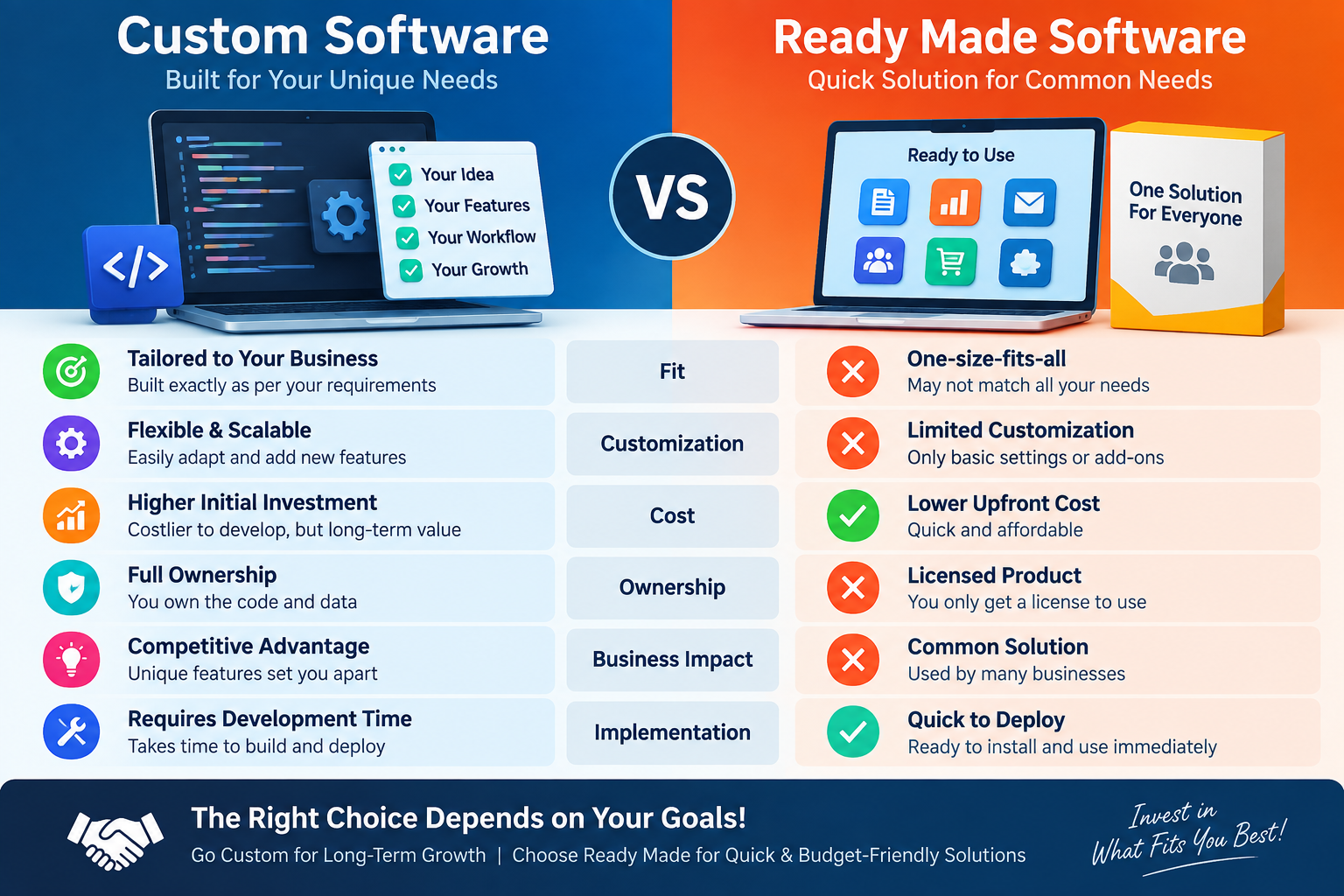
Custom Software vs Ready-Made Software
The key difference can be explained in one sentence:
Ready-made software provides a predefined solution. Custom software provides a solution designed around your requirements.
1. Custom Software Fits Your Business
Imagine your sales process looks like this:
Website Enquiry
↓
Lead Verification
↓
Salesperson Assignment
↓
Customer Call
↓
Quotation
↓
Follow-Up
↓
Negotiation
↓
Order Confirmation
↓
Invoice
↓
Delivery
A ready-made CRM may have a similar workflow—but not necessarily the exact workflow your business requires.
With custom software, you can design the process exactly as you want.
You can define:
- Who receives the enquiry
- How leads are assigned
- What information must be collected
- When follow-ups are created
- What notifications are triggered
- Who can approve quotations
- How orders are processed
- Which reports management receives
Your business workflow becomes the foundation of the software.
2. Complete Customization
One of the strongest advantages of custom software is flexibility.
With a custom application, features can be created according to your requirements rather than being restricted to a predefined product.
For example, a manufacturing company may require:
Production
- Production planning
- Raw material tracking
- Work orders
- Production status
Inventory
- Warehouse management
- Stock movement
- Low-stock alerts
- Product batches
Sales
- Dealer management
- Quotations
- Orders
- Customer history
Management
- Daily sales dashboard
- Profit analysis
- Employee performance
- Inventory reports
Instead of purchasing four or five separate applications, a business may be able to bring its important processes together into one connected system.
3. Custom Software Can Grow With Your Business
Your business today may not be the same business you operate three years from now.
You may add:
- New products
- New branches
- New employees
- New warehouses
- New sales channels
- New customers
- New markets
Your software should be able to evolve with those changes.
A custom software platform can be developed using a modular approach.
For example:
Stage 1
Website + Lead Management
Stage 2
CRM + Sales Management
Stage 3
Inventory + Billing
Stage 4
Employee & Branch Management
Stage 5
Mobile Application
Stage 6
Advanced Analytics + AI
This allows businesses to develop their digital infrastructure progressively instead of replacing the entire system every few years.
4. Automate Repetitive Business Tasks
One of the biggest reasons companies invest in custom software is business automation.
Consider a typical customer enquiry.
Without automation, an employee may need to:
- Check the website
- Copy the enquiry
- Add the customer to a spreadsheet
- Inform the salesperson
- Send an email
- Send a WhatsApp message
- Create a follow-up reminder
- Update the CRM
- Inform management
A well-designed custom application can automate many of these steps.
For example:
Website Form
↓
Lead Automatically Created
↓
Salesperson Automatically Assigned
↓
Customer Receives Confirmation
↓
WhatsApp/Email Notification
↓
Follow-Up Automatically Scheduled
↓
Management Dashboard Updated
This reduces manual work and helps ensure that important leads don't get forgotten.
5. Integrate Your Existing Systems
Businesses often use multiple applications.
For example:
Website + CRM + Accounting + WhatsApp + Payment Gateway + Email + Inventory
If these systems don't communicate with each other, employees may have to enter the same information repeatedly.
Custom software can be designed with integrations and APIs so that information can move between systems.
For example:
Customer Enquiry
→ CRM
→ Sales Team
→ Quotation
→ Payment
→ Accounting
→ Order
→ Delivery
The goal is to create a connected digital workflow.
6. Better Security and User Permissions
Not every employee should have access to every piece of information.
Custom software can implement detailed role-based permissions.
For example:
Sales Executive
Can view:
- Assigned customers
- Leads
- Follow-ups
- Quotations
Sales Manager
Can view:
- Team performance
- All leads
- Sales reports
- Customer activity
Administrator
Can manage:
- Users
- Permissions
- Settings
- System configuration
Management
Can view:
- Revenue
- Sales
- Profitability
- Business analytics
- Performance dashboards
This creates better control over sensitive business information.
7. Your Data Should Work for You
Modern businesses generate enormous amounts of data.
But simply storing data isn't enough.
The real value comes from turning that data into useful information.
A custom business dashboard can show:
Today's Leads
Today's Sales
Pending Follow-Ups
Outstanding Payments
Top Products
Top Customers
Salesperson Performance
Monthly Revenue
Conversion Rate
Management can therefore make decisions based on real-time business information rather than manually combining data from spreadsheets and different applications.
8. Custom Software Can Reduce Long-Term Complexity
At first, using several ready-made applications may appear convenient.
But eventually you may have:
- One CRM
- One accounting system
- One inventory system
- One HR system
- One communication tool
- Multiple spreadsheets
- Multiple passwords
- Multiple subscriptions
Employees then spend time moving information between systems.
Custom software can potentially bring many of these workflows together.
Instead of managing several disconnected systems, your business can have a centralized software platform.
9. Custom Software Gives You a Competitive Advantage
Imagine two companies competing for the same customers.
Both offer similar products.
But Company A has:
- Automated lead follow-ups
- Faster quotations
- Real-time inventory
- Automated customer communication
- Better reporting
- Faster decision-making
Technology becomes a competitive advantage.
This is one of the most important reasons to consider custom software.
The software itself can become part of your business strategy.
Is Custom Software More Expensive?
The initial investment can be higher than purchasing ready-made software.
That's because custom software requires:
Planning → UI/UX Design → Development → Testing → Deployment → Maintenance
But comparing only the initial price can be misleading.
Consider the total cost of your current software ecosystem.
You may already be paying for:
- Multiple software subscriptions
- Premium plugins
- Additional users
- Extra modules
- Third-party integrations
- Manual data entry
- Employee time
- Spreadsheet management
The important question is not:
"Which software is cheaper today?"
The better question is:
"Which solution provides better value for my business over the next several years?"
When Should You Choose Custom Software?
Custom software development may be the right choice if:
Your business has unique processes
Your workflow doesn't fit standard software.
You're dependent on Excel
Important business operations are still being managed manually through spreadsheets.
Your employees enter the same data repeatedly
This is often a sign that automation could save significant time.
Your current software has too many limitations
You regularly need features that your existing application doesn't support.
You use multiple disconnected systems
Your CRM, accounting, inventory, website, and other systems don't communicate effectively.
Your company is growing
Your current software may not be able to handle additional employees, branches, customers, or products.
You need complete control
You want greater control over workflows, data, permissions, integrations, and future development.
When Is Ready-Made Software Better?
Ready-made software can still be an excellent choice when:
- Your requirements are standard
- You need a solution immediately
- Your budget is limited
- You don't require significant customization
- Your business processes are simple
- You want to test a concept before investing in a larger system
The goal isn't to choose custom software simply because it sounds better.
The goal is to choose the technology that makes the most business sense.
Custom Software Development: An Investment in Your Future
Software shouldn't simply perform tasks.
It should help your business operate better.
The right custom software can help you:
Save Time
Automate repetitive tasks and reduce manual data entry.
Improve Productivity
Give employees tools designed around their actual work.
Increase Visibility
Provide management with real-time information.
Improve Customer Service
Respond faster and maintain better customer records.
Reduce Errors
Replace repetitive manual processes with automated workflows.
Scale Operations
Add users, branches, products, modules, and integrations as the business grows.
Create Competitive Advantage
Develop processes and features that competitors using generic software may not have.
The Right Software Is the One That Fits Your Business
There is no universal answer to the custom software vs ready-made software debate.
If your business has straightforward requirements and needs an immediate solution, ready-made software may be the right choice.
But if your business has unique workflows, complex requirements, multiple systems, growing operations, or a need for automation, custom software can provide significantly more flexibility and long-term value.
Your business shouldn't have to change the way it works just to accommodate software.
Your software should be built to support the way your business works.
Ready to Build Software Around Your Business?
If your current software is holding your business back, it may be time to consider a solution designed specifically for you.
We can help you transform your business processes into a secure, scalable, user-friendly software solution.
From CRM and ERP systems to inventory management, business automation, customer portals, dashboards, mobile applications, API integrations, and AI-powered solutions, custom software can be built around your exact requirements.
Let's Build Something That Works for You.
Discuss Your Software Requirements →
Request a Free Consultation →
Get a Custom Software Development Quote →
Frequently Asked Questions
What is custom software development?
Custom software development is the process of designing and developing software specifically for the requirements, workflows, and objectives of a particular business or organization.
Is custom software better than ready-made software?
It depends on your requirements. Custom software is generally more suitable for businesses with unique workflows, complex requirements, automation needs, or long-term scalability requirements. Ready-made software can be better for standard requirements and quick deployment.
Is custom software expensive?
Custom software generally requires a higher initial investment than ready-made software. However, its long-term value can be higher because it can be designed around your processes and expanded as your business grows.
How long does it take to develop custom software?
Development time depends on the complexity of the project. A small application may take weeks, while a large ERP, CRM, or business management platform can require several months.
Can custom software integrate with WhatsApp?
Yes. Depending on the requirements and the available APIs and services, custom applications can be integrated with WhatsApp-related business communication workflows.
Can custom software integrate with accounting software?
Yes. API-based integrations can allow custom applications to exchange information with supported accounting and financial systems.
Can custom software be accessed from mobile devices?
Yes. Custom software can be developed as a responsive web application, mobile application, or both depending on the business requirements.
Who owns custom software?
Ownership depends on the development agreement and intellectual-property terms. Businesses should clearly define ownership of source code, data, designs, and other deliverables in their contract.
Can AI be added to custom software?
Yes. AI capabilities can be incorporated into custom applications for tasks such as document processing, customer support, data analysis, recommendations, automation, and business insights.